Life and Work of Jaap Schreurs (1913-1983) Painter and father |
|
1934-1942 2nd period |
|
|
|
 |
Jaap picked up the technique of painting with oil in his home environment. He found his subjects mainly in people and their varying fortunes.
Over the years, he would renew his techniques several times and went from his initially classical color schemes and images to working with various materials and new forms of expression.
Selfportait oil on canvas ± 1940 |
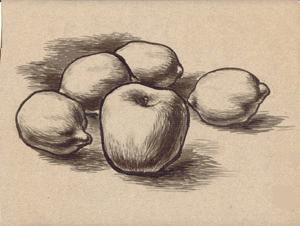
Still life ± 193? ink on paper |
|
|
To his regret, Jaap had not attended secondary school. One of the consequences of this was that he was not admitted to the Royal Academy. But he managed to get into the Free Academy. Moreover, he was allowed to join a group of private students of the Hungarian painter Ference Erdely. Together, they could afford to rent a studio space. For Jaap this became a place where he could work every day.
|
|
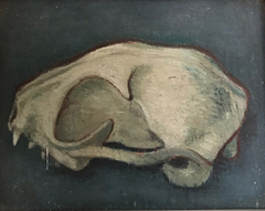
Animal skull |
 |
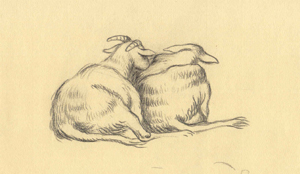
Sheep 14,6x23,1cm pencil on paper
|
Jaap felt deeply for his fellow men. In his work, he consciously sought out human suffering in crisis situations around him. At the Salvation Army shelter, he met people who were willing to pose for him in exchange for a hot meal.
|
study of varaious figures ± 1934 |
|
|
olie on board 20x36cm ± 1938 |


Later he would tell his daughter Paula that in the winter it was so cold in the studio (this was during the Depression) that he had to heat his stiffened hand, with the brush still in it, over a candle before he could change brushes.
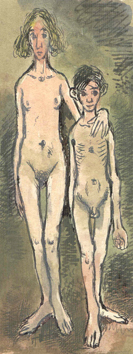
In his work, he also touched on the themes of submission and dominance in partner relationships |
|
Two skinny children 1 1,5x25,5cm gouache ± 1940
|
olie on board 27x40cm ±1940
|
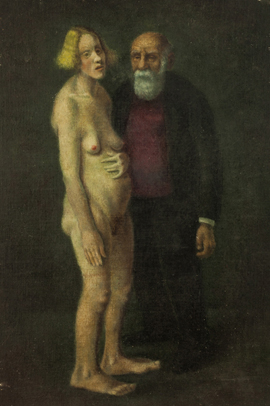
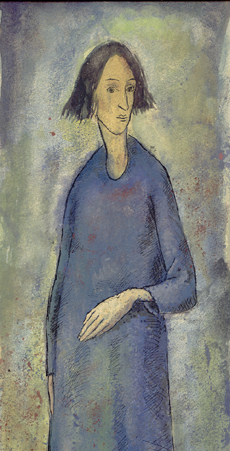
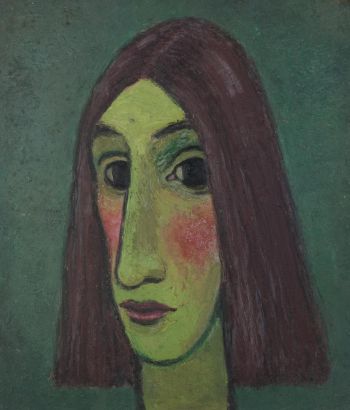
Ference Erdely was employed as a teacher at the Royal Academy in The Hague. He gave private lessons to the small studio group and because of his exceptional talent he also allowed Jaap to attend his private lessons. He taught portrait drawing and painting. This training can easily be recognized in Jaap's work: The faces are worked out into expressive characters, while the clothing remains relatively underdeveloped.
|
gouache on paper 1935
|
|
Oil on canvas 45x38cm ± 1939
|
|
Jaap was also inspired by scenes he saw happening on the street. Not everyone could afford a newspaper…
|
"The latest news" ± 1941 water colour on paper |
|
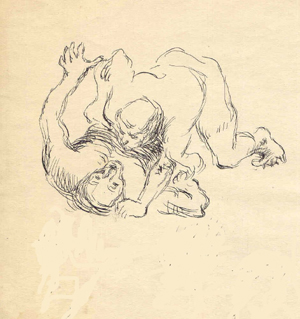
Brawl, ink on paper ± 1935 |
|

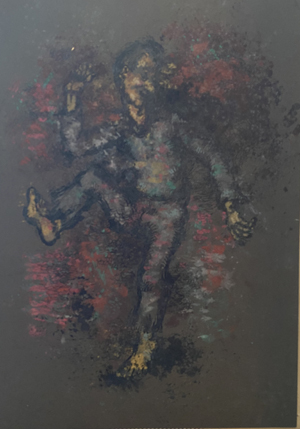
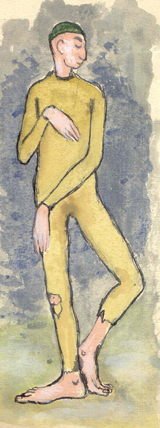
While both Jaap's father and his childhood friend Willem van Beekum developed their craft into a usable applicable professional skill, Jaap stayed close to himself and portrayed his own moods. With this he evoked some raised eyebrows, stonishment, but also garnered admiration for his authenticity and daring.
|
Dancing man gouache op cardboard ± 1937 |
Pierrot gouache on paper ± 1935 |
|
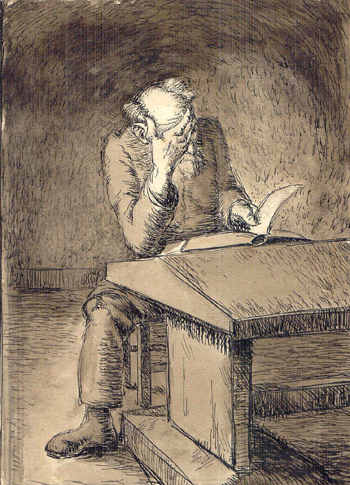
All his life Jaap was fascinated by religions and other outlooks on life. He had an inquiring mind, was not a churchgoing person and after an initial exploration of the Rosicrucian movement, Theosophy and astrology, it was the vision of Krishnamurti that became his permanent reference point and also lifelong guide. This also permeated our upbringing. He insisted that we should not be baptized, because he wanted to keep us free from pre-imprinted images of God.
In his work, we saw how a number of themes in this area would regularly recur. |
india ink coloured on paper ± 193? |
Jezus amongst crowd oil on panel 32x24cm ± 1938
|

|
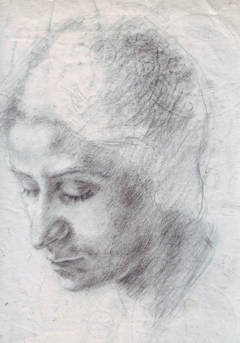
In those years, Jaap lived with his Jewish girlfriend Selma Sarphaty. During the war years she was able to go into hiding with a pastor's family. But when she had to change addresses, Jaap lost sight of her; Jaap himself also went into hiding.
|
Selma pencil on paper ±1935
|
Selma oil on canvas ±1939 |

|
war and marriage |
|
childhood and family of origing |
|
overview over periods |
by Nelleke and Paula |
|